



"Is This Actually Moving the Business?" What marketing leaders debated at NYC Tech Week.
The future of commerce isn't about replacing human decisions with AI, but strategically redesigning your operations to build authentic authority in an agentic world.

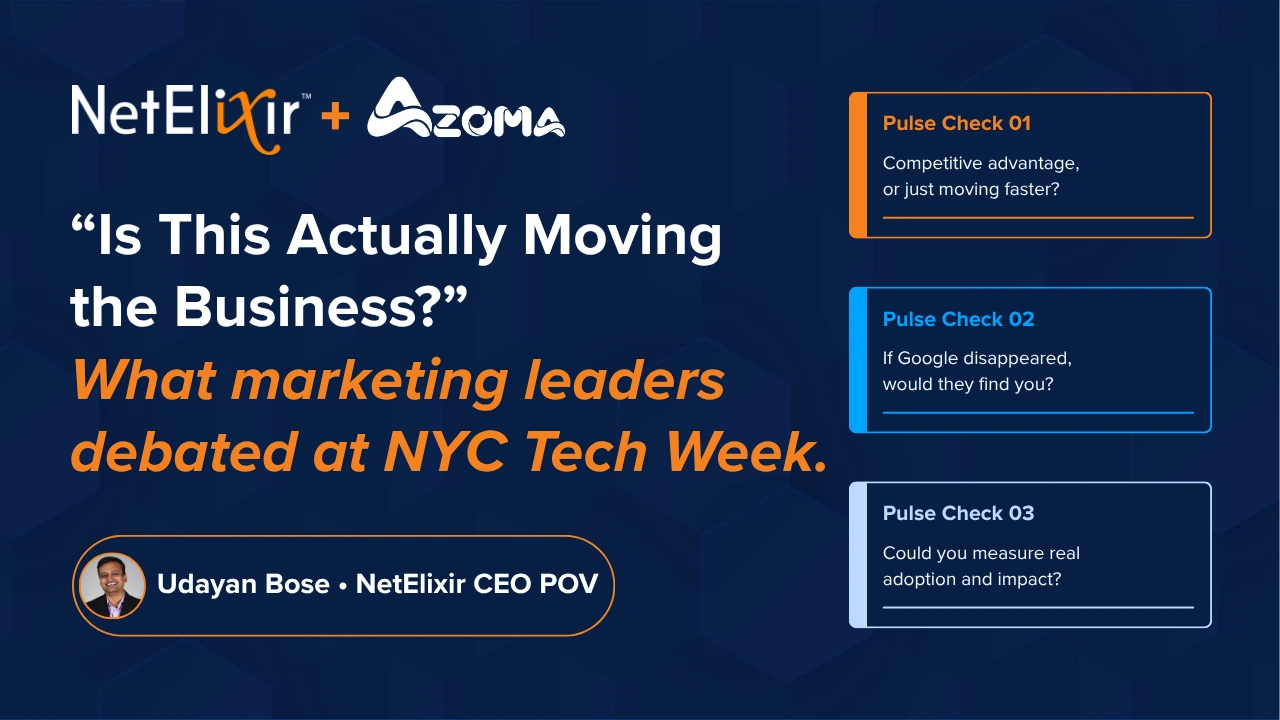
At Azoma's Agentic Commerce Decoded event during NYC Tech Week, NetElixir Founder and CEO Udayan Bose joined fellow industry leaders for a panel discussion exploring the opportunities, challenges, and realities of AI adoption in commerce and marketing.
If there was one takeaway from the event, it was this:
The conversation has moved beyond whether AI matters.
The questions executives are wrestling with now are much more nuanced:
- Is AI creating competitive advantage or just accelerating existing processes?
- How do brands prepare for a world where discovery looks fundamentally different?
- What does meaningful AI adoption actually look like?
- Which customer experiences should become frictionless, and which should remain deeply human?
The room was filled with diverse perspectives. There wasn't consensus on every topic. There was, however, agreement that the status quo definition of success is changing.
The New Opportunity for Brands of Every Size
During the discussion, Udayan Bose shared an observation that challenged one of marketing's longest-standing assumptions.
"AI is the best opportunity we've had for authentic brands to stand out and get noticed, no matter the size of the company."
Historically, visibility favored brands with the largest budgets, strongest search positions, and years of accumulated authority.
AI introduces a new dynamic. Recommendation engines increasingly reward brands that provide clear answers, trusted expertise, useful experiences, and structured information that can confidently be surfaced to consumers.
As the discussion evolved, another tension emerged:
"One of the struggles that existing companies face is dealing with legacy operating systems. But imagine the company being built today. The company that doesn't know anything about legacy operations and doesn't need to. Does this even the playing field?"
This question generated some of the evening's most diverse viewpoints.
Does AI advantage incumbents because of their scale and resources? Or does it advantage challengers because they aren't burdened by decades of disconnected systems and outdated processes?
The answer wasn't definitive. But the possibility itself signals a major shift:
Competitive advantage may increasingly belong to the organizations willing to redesign how they operate, not simply optimize how they've always worked.
Not Every Customer Decision Should Be Automated
Agentic commerce often sparks visions of autonomous purchasing and predictive shopping experiences.
Udayan pushed the audience to think more critically.
"People think the next wave of AI is knowing what consumers want before they know they want it, and all of a sudden the item is sitting on your doorstep. That's creepy, and probably not the next step in the agentic world."
Instead, the discussion focused on identifying where friction actually exists. Some decisions are repetitive. Others are experiential. Some should be delegated. Others should remain entirely human.
He illustrated this through a simple framework:
"Every time you buy toilet paper, do you want to search and vet twenty different toilet paper brands? No. That friction can be removed through AI."
"Do you want to go shopping for fun and compare different bags or shoes? Yes. That's not a friction point."
"Do I want the agent to buy my next BMW? Definitely no."
The future of agentic commerce isn't about eliminating every decision. It's about understanding which decisions consumers want help making, and which ones they don't. The winners won't remove friction indiscriminately. They'll remove the right friction.
Three AI Readiness Pulse Checks
Udayan challenged leaders to continuously assess their organization's preparedness through three questions.
1. Is AI creating competitive advantage or just helping you do the same work faster?
Many organizations are accelerating existing workflows. The bigger opportunity lies in redesigning them.
Can AI help uncover new customer opportunities?
Can it create new experiences?
Can it enable faster, smarter decisions that weren't previously possible?
Efficiency is valuable.
Advantage is transformative.
2. If Google disappeared tomorrow, would customers still discover your brand?
Discovery is evolving. Brands increasingly need to build the authority, experiences, and trust signals that AI systems can confidently recommend.
The greatest opportunity comes from connecting workflows across teams and systems rather than automating isolated tasks.
Discovery becomes an organizational capability, not simply a media strategy.
3. Can you measure adoption and business impact?
One of the evening's strongest punchlines challenged how organizations define success.
"Having 1% of your workforce use Claude once a week isn't the same as achieving meaningful AI adoption across the organization."
Usage alone is not impact.
Organizations should focus on measuring:
- Workflow utilization
- Efficiency gains
- Decision quality
- Revenue outcomes
- Speed to execution
- Improvements to customer experiences
Activity is easy to count.
Business outcomes matter.
Garbage In, Garbage Out
The discussion also grounded the room in a reality many organizations overlook. AI readiness starts with data readiness. As Leo Nagdas of dunnhumby pointed out:
"The average brand has millions of attributes and 20–30% gaps or errors across product data."
The implications are significant. Poor product information feeds poor recommendations. Incomplete attributes limit discoverability. Disconnected systems weaken customer experiences.
The principle remains simple:
Garbage in, garbage out.
Before organizations can expect AI to generate meaningful outcomes, they need confidence in the quality of the information powering those systems.
The Questions Leaders Left With
The most valuable conversations weren't about prompts, tools, or the latest model release.
They centered around organizational choices.
- Which workflows should be reinvented?
- Which customer experiences deserve less friction?
- How should brands prepare for new forms of discovery?
- How do we define meaningful adoption?
- Is our data ready for the future we're building toward?
- Are we creating competitive advantage or simply moving faster?
The organizations that thrive in the next era of commerce won't necessarily be those with the biggest budgets or the most AI subscriptions.
They'll be the ones willing to rethink how value gets created, how decisions get made, and how customers discover them in the first place.
Thank you for your interest in Agentic Commerce Decoded. If you'd like to continue the conversation, feel free to schedule time with NetElixir Founder and CEO Udayan Bose.
We're also pleased to share NetElixir’s latest State of AI in Marketing Report with attendees. We welcome your feedback and would enjoy discussing how these insights can help shape your organization's AI and commerce strategy.
Read more Articles


Boost your Amazon sales performance with these three proven, data-driven pre-event advertising strategies.
AI has improved operational efficiency, but it hasn’t yet mastered business performance.

AI has improved operational efficiency, but it hasn’t yet mastered business performance.

Join the

Community
A space for thinkers and doers. Join and get updates on events, webinars, product innovations, Ai and more!